SamSamWater Rainwater Harvesting ToolStep 4 of 4 (results)
Summary of results
There is no need to construct a large storage reservoir, since in every month the water availability is enough to fulfil the demand.
A small storage volume to bridge a number of days without rain should be enough to provide an adequate water supply throughout the year.
Details on the results and calculations can be found below.
Location
Location:
Latitude:
degrees
Longitude:
degrees
Roof size:
square metres
Roof type:
Runoff coefficient:
Water demand:
litres per day
Rainfall
The average rainfall at this location varies between 0 mm in the driest month (January) and 0 mm in the wettest month (January). The total annual rainfall in an average year is 0 mm.
Water availability
A roof has a runoff coefficient of , which means that 0% of the rain can be harvested. Based on this runoff coefficient and a roof area of square metres a volume of 0 litres (0 mm x m² x ) of water can be collected in the driest month (January) and 0 litres (0 mm x 30 m² x ) in the wettest month (January).
The total yearly amount of water that can be collected from the roof is 0 litres (0m³) in an average year.
Water demand
The water demand is litres per day, which equals to about 0 litres per month. The total water demand is 0 litres (0 m³) per year.
During every month the amount of water that can be collected from the roof is larger than the water demand.
Required storage
Since the amount of water that can be collected from this roof is enough to fulfil the demand, even in the driest months, no large storage reservoir is required. A small storage volume to bridge a number of days without rain should be enough to provide an adequate water supply throughout the year.
Dry and wet years
This calculation is based on the average monthly rainfall. The actual rainfall differs from month to month and year to year. The amount of available water and filling of the tank might therefore be different and change from year to year.
When constructing a rainwater harvesting system it is important to take this into account. Below is a description of the situation in a dry year (20% chance) and a wet year (20% chance).
Situation in a dry year:
the amount of water that can be collected from the roof is larger than the water demand. A small storage volume to bridge a number of days without rain should be enough.
Situation in a wet year:
there will be more than enough water to fulfil the demand. A small storage volume to bridge a number of days without rain should be enough.
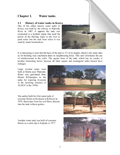
Neil Herath, Comminity Water Supply & Sanitation Project (CWSSP), Ministry of Housing, Construction & Public Utilities, Sri Lanka (1995)
this document has been scanned from earlier manuals and standardizations prepared by Neil Herath for CWSSP – Sri Lanka ( April 1995), and as Manual 3 of the Technical Manual Series on Rural Water Supply and Sanitation, Gravity Water Supply Systems: design and construction (January 2005). It is redesigned to look like the 2005 CWSSP manual guiding field work on wirereinforced cement mortar tanks, commonly known as ferrocement tanks (Han Heijnen, October 2010) (source)
This document addresses RAINs guidelines towards water quality and gives criteria and practical guidelines to improve and maintain an acceptable water quality of harvested rainwater for drinking purpose. (source)
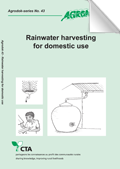
Book Agrodok 43: 'Rainwater harvesting for domestic use' with useful and practical applications of rainwater harvesting in developing countries. (source)
Organizations with experience in the construction of rainwater harvesting systems
SamSamWater Foundation aims to increase the number of people in developing countries with sustainable and reliable access to water and sanitation.
'SamSam' means 'together'. We work together to reach our goal: safe and reliable water to all! We believe in practical solutions, realised in close collaboration with our partners and beneficiary communities.
RAIN is an international network with the aim to increase access to water for vulnerable sections of society in developing countries - women and children in particular - by collecting and storing rainwater.
Started in December 2003, RAIN focuses on field implementation of small-scale rainwater harvesting projects, capacity building of local organisations and knowledge exchange on rainwater harvesting on a global scale.
Acacia Water “for solutions in groundwater” was established in 2003 at the Vrije Universiteit Amsterdam (Faculty of Earth and Life Sciences). Acacia Water focuses on groundwater in relation to surface water, environment and infrastructure. This varies from implementation of field measurements and model calculations, to giving training and strategic advice. Acacia distinguishes itself by the cooperation with the University, as a result of which Acacia Water has access to the latest scientific developments in the field of hydrology and environment. We translate this knowledge to innovative and practical solutions.



 Show information on the construction and maintenance of rainwater harvesting systems.